 Moderate
Pratapgad Fort
Western Ghats, Maharashtra
4-5 hrs · best in monsoon
Sunrise TrekHistoric Battle Site
View details
The capital fort of the Maratha Empire where Chhatrapati Shivaji Maharaj was crowned in 1674.
See also: Passing at Raigad (Timeline); Coronation at Raigad (Timeline).
Raigad rises steeply out of the Sahyadris above the Konkan, and for the last six years of Chhatrapati Shivaji Maharaj's life it was the seat of the Maratha state. He took the hill, then known as Rairi, from the Mores of Javli in 1656, renamed it Raigad, and had it rebuilt as a capital rather than merely a stronghold. It was here, in June 1674, that he was crowned Chhatrapati.
What survives is the plan of a working capital. The climb passes through the Maha Darwaza, set deliberately between two bastions so that anyone approaching the doors could be fired on from both sides. Above it the plateau opens out: the twin rows of the Bazaar Peth, laid out so mounted traders could deal without dismounting; the Raj Sabha where the court sat; rock-cut reservoirs including Ganga Sagar that carried the garrison through the dry months; and the cliff edge at Takmak Tok with a long drop to the valley below.
Shivaji Maharaj died at Raigad in 1680 and his memorial stands before the Jagadishwar temple at the eastern end of the plateau. The fort fell to the Mughals in 1689 and passed to the British in 1818. Today it is reached either by roughly 1,450 stone steps or by a four-minute ropeway, and the plateau is broad and level enough that most of a day is well spent up there.
Key events, chronologically. Each is fact-checked against cited sources.
Shivaji is crowned Chhatrapati, formally establishing the Maratha kingdom.
Chhatrapati Shivaji Maharaj passes away at Raigad Fort.
Nearest city: Mahad · 25 km. Distances are approximate.
Loading map…
An editor’s walk-through of the fort’s notable structures, in the order you’ll meet them.
The main gateway, set between two towering bastions so attackers could be fired on from both sides before reaching the doors.
1 hr 40 min from entrance
The audience hall where Shivaji Maharaj was crowned Chhatrapati in 1674. A replica throne now marks the original seat.
2 hrs from entrance
A modest Shiva temple in the eastern quarter, built in the Deccan style and still in worship today.
2 hrs 15 min from entrance
The memorial marking the resting place of Chhatrapati Shivaji Maharaj, immediately in front of the Jagadishwar temple.
2 hrs 20 min from entrance
The cliff-edge bastion tied to the legend of Hirakani, the milkmaid who climbed down the sheer rock face at night to reach her child.
2 hrs 30 min from entrance
A sheer promontory at the fort's western edge with a long drop to the valley. Fenced today, and the fort's best sunset vantage.
2 hrs 45 min from entrance
Two long rows of stone shop foundations along the market street, laid out so mounted traders could deal without dismounting.
2 hrs 10 min from entrance
A rock-cut reservoir that supplied the fort year-round and still holds water through most of the year.
2 hrs 5 min from entrance
Practical trail facts to plan a safe climb.
Editor-picked stops worth pairing with your visit.
Winter brings the clearest skies and the most comfortable climbing weather, with long views across the Sahyadris. The monsoon turns the hill green and dramatic but makes the rock-cut steps slippery and often hides the summit in cloud. Peak summer is best avoided: there is little shade on the stairway and water runs scarce.
Common questions, answered plainly.
Yes. A ropeway runs from near Pachad village to the fort plateau and takes about four minutes, which makes Raigad accessible to visitors who cannot manage the stairway. It does not operate in high wind or heavy rain, so be ready to walk down if conditions change.
Roughly 1,450 stone steps from the base to the main gateway. Most reasonably fit walkers take between two and three hours at a steady pace with rest stops.
With the ropeway, yes. The plateau itself is broad and mostly level, so once you are up top the walking is easy. The stairway climb is long and exposed and is better suited to those used to sustained uphill walking.
Plan a full day. The plateau is large and the main sites are spread across it, so seeing the court, the memorial, the market street and Takmak Tok comfortably takes three to four hours on top of the ascent and descent.
There is basic MTDC accommodation and a few guest rooms on the plateau, usually best booked in advance. Many visitors instead stay in Mahad and start early the next morning.
Moderate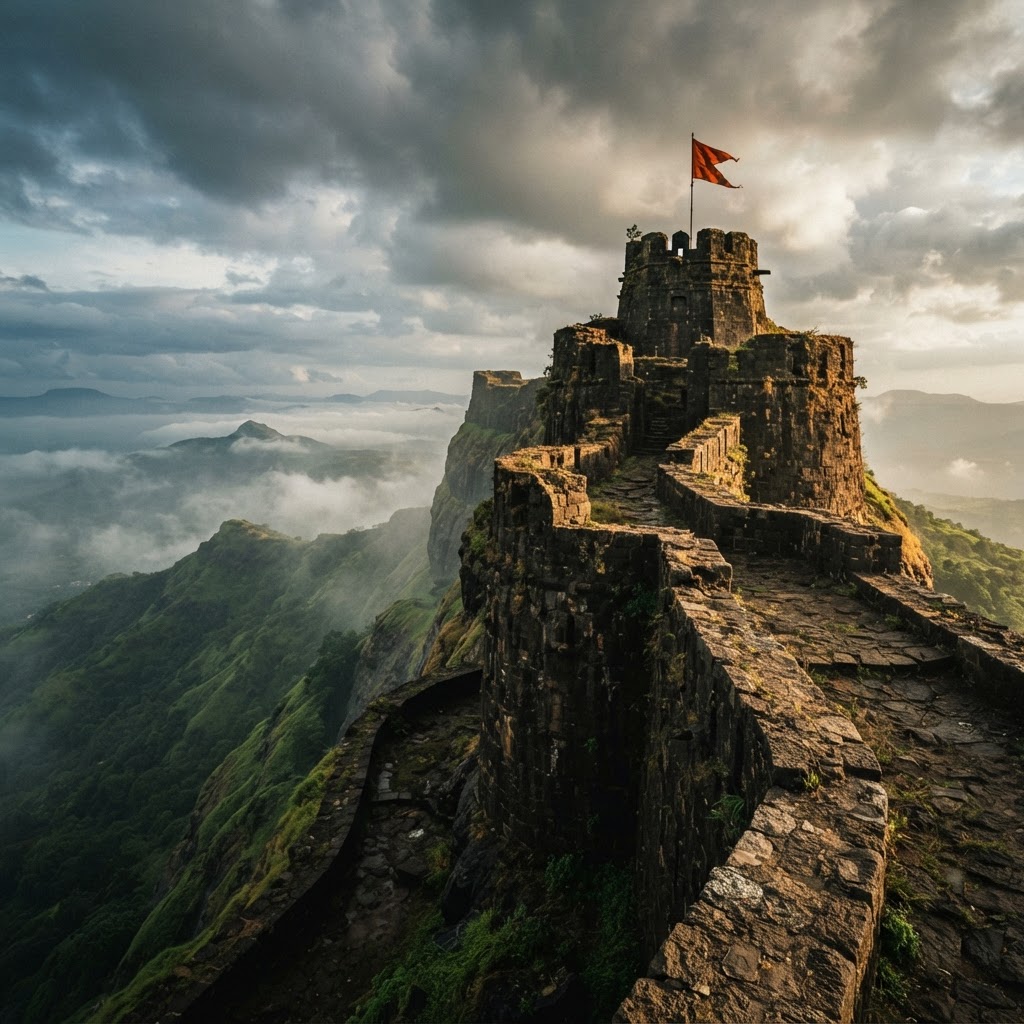 Easy
Easy